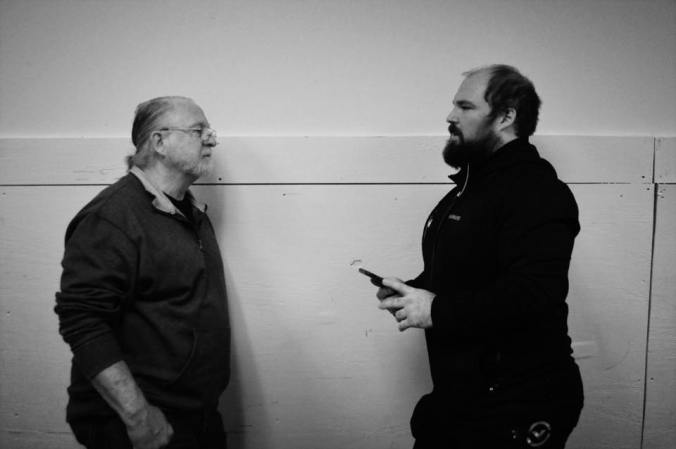
 I have struggled near two weeks now to put into lengthier form how I feel about the passing of Don McCauley. Conceptually, I envisioned writing about Don in the three phases he was in my life: purely as a Coach and Colleague; as a close personal friend and struggling business partner; and an old man and a young boy in room alone the last time I saw him.
I’ve struggled to execute this concept for a number of reasons. First and foremost, I want to celebrate Don’s life and all who he touched as athletes, coaches, and humans. That should be the raison d’etre for anything written about Don. You will find traces of him everywhere in our relatively small, but growing community.
I want to sit here and type all the things I first remember him teaching me as an exceptionally mediocre athlete. About the hours on the road we shared solving all the world’s problems with our unifying but flexible set of “guidelines”. How he was there to watch two of his pupils fall madly, embarrassingly, unapologetically in love with each other and the feeling of sanctity his blessings gave us. I’d like to tell you all the stories I’ve jokingly sketched about his father working for the Providence, RI Mafia, my only logical conclusion given his father’s string of odd professions (including “The Butcher”) or his gold-ornamented lawyer friend, Joe Rodeo, who wept at his father’s funeral accompanied by two suspiciously large body men. I hope, someday, I will be able to visit more with Don’s family and learn from his two brothers about his younger life, or perhaps from their mother who has had to bury her oldest son.
In fact, I would like to write just about fucking anything, because I really need to be getting some work done. But every time I stare at a blank page and attempt to write about anything, I can’t help but think about Don. Maybe this is because Don was famously quite verbose, particularly in the written form, having studied journalism and published his own book. It could be because we would trade books or even book ideas, and that storytelling was a cherished part of Don’s life.
Mostly, I think it is because I am riddled with grief that I’ve refused to acknowledge has been building for about a year and a half. So I am writing this for me. It is of course about Don. But it is not for him. It is not even for you, the reader. It is for me to begin to find some sort of peace, whatever the fuck that means, through this grief that is crippling me underneath the surface.
Cancer is in my family, and in it strong. Of the six siblings that were born in Ireland in my family, four have succumbed to cancer. When I die, it will probably be from cancer. There are so many things in Don’s life that he should have died from that, while unpleasant, would’ve been a quick and relatively painless end. When he told me what his diagnosis was, I ignored all of my life’s experience that taught me explicitly how his condition would come to an end.
For whatever reason, my brain immersed itself in the strongest form of cognitive dissonance possible. We knew what kind, what stage, and what time he would have. I had all the facts in front of me and read papers reasserting those facts. I instead, chose to believe the experimental trials working in mice and rats would get to him in time. That he could be the 1% of survivors. That my friend, who is perhaps the only man on Earth more stubborn than myself, could exert his will one more time in defiance of the natural order of things. What could be more “Don” than sticking it to an unbeatable cancer?
Initially, Tayler and I offered to take him into our care when he told us. I wanted to be there for the latest updates and make sure he had everything he needed. Instead, he was taken into care by his brothers, who were far better and more necessary caretakers than we ever could have been. This move, however, facilitated a secure place for my head to retreat in the sand. Out of sight, and out of mind. Don is doing fine, I pretended. In the best care possible and enjoying the glow of the Florida sun.
Tasked with my own duties of running a business and training to be a competitive weightlifter of some kind, our communication reduced to periodic calls. I transitioned into avoidance. The two sides of my brain weren’t able to reconcile the belief that Don could make it and that defeat was inevitable. Avoiding the situation entirely was simply more convenient.
During our occasional calls, we could still talk about weightlifting, books, movies, politics. All of our favorite topics. Even if Don was flat out wrong about some of them. Sometimes the tumors grew disruptive enough to cause his seizures, making communication more difficult. His sentences began to ramble longer than usual. Thoughts and concepts became more difficult to convey. Eventually, words would be too difficult to recall, even simple articles. His writing went first. Instead of messaging me, he began recording voice memos. These would stop too, and be followed by links to things he saw that would convey a point he wanted to make, but couldn’t verbalize.
I didn’t visit, I told myself, because I was busy. And that’s true. It is hard enough to have my gym run without me while I’m away for competitions, or getting the funds together to travel around the world for my competition schedule. A perfect storm of events occurred that could put off my visit no longer.
I got a voice memo from Don in the middle of the night.
“I wanted to tell you. I think this is it. I’m dying.”
Never once in his diagnosis or treatment did Don admit defeat to me. Until this. Fortunately, he was wrong. Well, temporarily. It was a bout of seizures that were giving him some trouble, but he was otherwise doing ok.
Then Glenn Pendlay died. As conflicted as I feel about Glenn’s life and my relationship with him, I felt great remorse in not visiting him before his passing, and with the suddenness of Glenn’s condition I don’t know that I could have done anything to change that. What I did know, is that I couldn’t allow it to happen with Don.
Before leaving to compete in the World Championships, I flew to Florida, both to visit Don on one side of the state and then to coach our team on the other. This is among the worst ways you can prepare for the most important competition of your life. But it had to be done.
I had dinner with Don’s brother, Bill, who had been keeping me updated. I had no idea what Bill looked like, or knew much about him. But his voice was a dead ringer for Don’s. The next day I visited the nursing home Don had been placed in for his caretaking. The McCullough family had arrived before me and were sat around Don in his wheelchair.
The half of his face that still operated turned into an excited smile. I don’t know if anybody other than Tayler has ever been that happy to see me walk into a room. He waved me over with the hand that could still move. I hugged him and he kissed me on the cheek, something he’s never done the entirety of our time together. We all sat and shared our stories of what had been going on in the world or training.
I said “the half of his face that still operated”, because Don’s seizures had paralyzed him on the right side, which is what necessitated his care in the facility. He could not stand under his own power or have function of anything on that side.
Don could only grasp a word at a time and had great difficulty continuing any sentence. He could, however, completely understand what you spoke to him and followed along well enough. He had a laminated card with a grid of words like “weightlifting”, “catapult”, “hungry”, “bathroom”, etc. On the other was the alphabet and numbers so that he could potentially spell out a word not on the grid. He never made it past the first letter, and much of our time was spent playing charades with an increasingly dejected Don. The McCulloughs hit the road so Morgan could train and I followed Don and the nurse on duty back to his room for his lunch.
Following down the hall from the visitors area, an overwhelming odor of death became evident. The bright and shiny lobby hid you from the aging, fluorescent hallways traversed by the wheelchair bound who could still move under their own will, but unsure of exactly where they were. The nurse on duty quickly acquired a meal from a stack of trays and set Don up in his chair for lunch.
He was able to ask, “the girl?” I sat with him drinking cold coffee and told him about Tayler’s lifting and her International trips. I told him about her new job and how much happier she was now. I talked about how coaching is the best job in the world and running a gym has got to be among the worst. I asked if he knew about Glenn’s passing. He nodded and raised his glass of water solemnly in remembrance. I told him I was leaving soon for Thailand and he intimated that he wanted the live stream to watch.
His occupational therapist appeared in the door and said she needed time to work with him. I removed myself to sit outside the door until they were finished. She asked him questions about how he was feeling, to which he couldn’t respond, using that loud voice one uses for children, the handicapped, or the deaf. He could hear her just fine. He just couldn’t answer her questions.
She tested his physical abilities on the paralyzed side. She talked about setting goals like “sitting up out of bed on his own” that they would work towards. I wept quietly so he wouldn’t be able to hear. After ten to fifteen minutes she walked out.
“Are you Donald’s son?”
I choked, “No, not exactly.”
When I came back in, he let me know he wanted to lie down and was done with lunch, but he didn’t have a way to tell anyone from his wheelchair. I walked down the hall to tell the nurse on duty that he’d like to be put in bed. She said someone will be there eventually.
I asked him if there was anything he wanted me to send him, like books. He just shook his head sadly and told me with his eyes that he couldn’t read them anymore. I put on the t.v. and tried to find something he might like to watch. After a rousing charades session, I figured out that he wanted his Team MDUSA shirt that said Coach McCauley if I could find it. And that he wanted more pictures.
He told me his back was hurting from being in the chair too long, so I investigated about when someone was coming to help. I discovered that there was one person on “lifting duty”, and she was going room by room far down the hallway and making incredibly slow progress. I rolled him to the bedside and, with some trial and error, was able to lift him into bed and get him comfortable.
At this point, he’s fighting to stay awake and I knew I had to tell him everything that I might not get another chance to. That he was the best friend and teacher a person could ask for. That we loved him very much. Our lives were significantly better for having him in them.
I saw him shed tears for the first time in our friendship, even if only one or two solitary ones before he did something I will never forget. Tayler and I were not shy about letting Don know that we loved him over the years. The regular response we got was, “yeah, yeah, yeah.”
He pointed at himself, used his able hand to lift the paralyzed one and place it on his chest, forming a heart with his fingers, and then pointed at me.
I left and sat in my rental car for around thirty minutes, screaming and weeping. A year and a half of avoiding grief washing over me in a moment. One of the greatest, authentic, and genuine communicators I had ever met was reduced to miming so he could say goodbye to me. For Don, being unable to speak, or write, or coach must have been far worse than dying. I think that may have been the reason why his last breath came just a few days after his 72nd birthday.
In life there is a natural progression of how we will meet and face death. Humans are uniquely aware of their own mortality, and that death will find us all some day. Long before that, the people in your life will meet that fate. The order of this is usually your older family members: grandparents, parents, maybe siblings. Then your peers: your friends, perhaps your spouse.
One of the problems with Don’s passing, is that he is my peer, my very good friend. I haven’t acquired the maturity and experience with death yet to be ready for my peers to pass, and hopefully I still won’t for a long time yet. Friends are the family you choose. Nothing can replace family, but there are members of the world out there, not many of them, that are kindred spirits who are long, lost family members. At least they are for me. I’m lucky to still have so many of you left.
The last thing Don has taught me is how not to handle the decline of someone you care a lot about. It’s the same story anyone ever tells you with a death: “I wish we had spent more time together.” For me, this isn’t just a lesson on cherishing the moments you have, but determining which moments and which people are the most important. If it’s important, it has to be a priority, regardless of what other perceived responsibilities may conflict. I ran away and avoided Don’s fate, and my punishment is not having more time with him. I’m hoping that never happens again. But, much worse than dying or this immense feeling of loss, would’ve been never getting the time we did have. I’m sorry I couldn’t write something more flattering, or a better memoriam this time, Don. I’ll try to do better next time and talk about the meaningful ways you improved all our lives.
 on poetics